
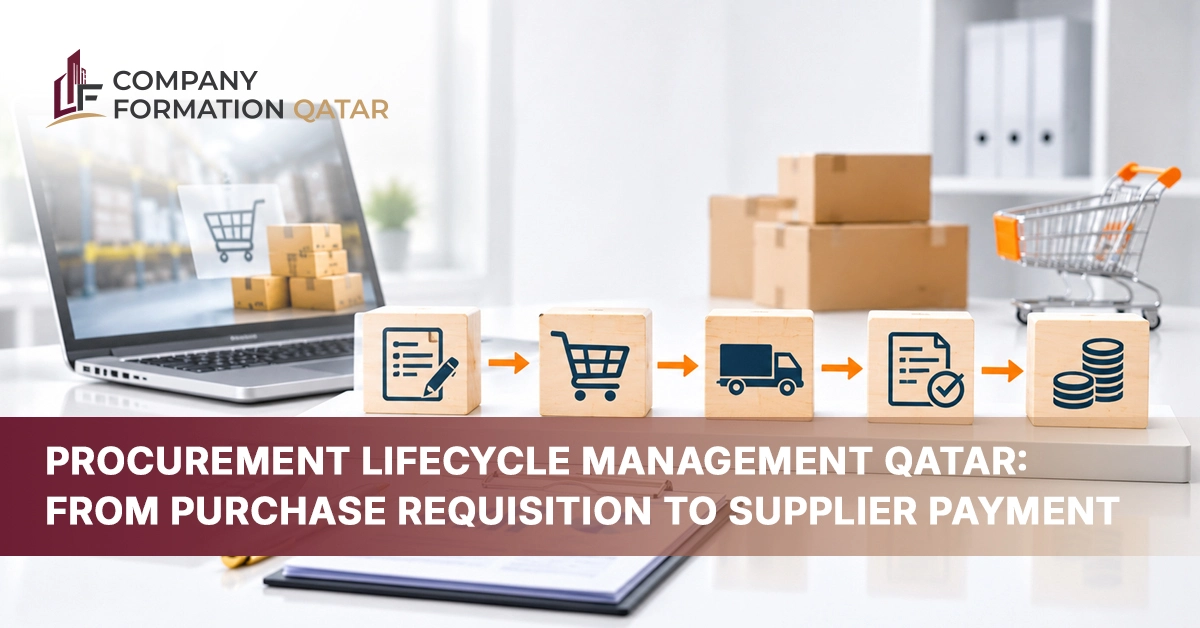
A purchase does not end when a department receives approval to buy something. The business must also identify a suitable supplier, compare quotations, issue a purchase order, confirm delivery, check the invoice, and release payment. If any of these activities lack proper controls, the organisation may face unnecessary expenses, delayed deliveries, duplicate orders, or disputes with suppliers.
Procurement Lifecycle Management Qatar refers to the coordinated management of purchasing activities, beginning with an internal purchase request and ending with supplier payment and performance review. For businesses operating in Qatar, an organised purchasing system helps maintain financial control, improve supplier relationships, and ensure that goods and services meet operational requirements.
Company Formation Qatar supports investors and businesses with company establishment and related registration requirements. Once a company begins operating, its management must also establish suitable internal procedures for purchasing, supplier selection, and financial approvals.
What Is Procurement Lifecycle Management?
Procurement lifecycle management covers the activities involved in acquiring goods, materials, equipment, and services for an organisation. It establishes how purchasing decisions are requested, assessed, approved, completed, and recorded. A well-managed system connects departments such as finance, operations, procurement, legal, and inventory management. Each department has a defined responsibility, reducing confusion over who can request purchases, approve expenditures, or authorise payments. The process generally includes:
- Identifying a business requirement.
- Preparing and approving a purchase requisition.
- Selecting and evaluating suppliers.
- Requesting and comparing quotations.
- Issuing a purchase order.
- Receiving and inspecting goods or services.
- Verifying invoices.
- Authorising supplier payments.
- Reviewing supplier performance.
The Main Stages of the Procurement Lifecycle in Qatar
Understanding each stage helps businesses identify where delays, unnecessary expenditure, and control weaknesses may occur.
1. Purchase Requisition and Requirement Identification
The lifecycle starts when a department identifies a requirement. For example, a construction company may need building materials, while a technology business may require computers, software licences, or technical support. The requesting department prepares a purchase requisition containing:
- Description and quantity of required items.
- Business purpose of the purchase.
- Estimated cost.
- Required delivery date.
- Department or project budget.
- Supporting specifications, where necessary.
The responsible manager checks whether the purchase is necessary and whether a sufficient budget is available. Approval should take place before the procurement team approaches suppliers or commits the organisation to expenditure. A clear requisition prevents unauthorised purchases and gives the procurement team sufficient information to proceed.
2. Budget Approval and Procurement Planning
After receiving the requisition, the finance department checks the available budget and confirms whether the expenditure fits the organisation’s financial plans. Businesses should consider existing inventory, outstanding orders, expected demand, and cash flow before approving new purchases. This is particularly useful for companies managing several projects or operating across multiple locations in Qatar.
A documented procurement strategy helps management decide how frequently to purchase materials, which suppliers to approach, what approval levels to apply, and how to manage purchasing risks. For recurring requirements, businesses may plan framework agreements or scheduled orders instead of processing separate requests each time. However, the suitability of these arrangements depends on demand patterns and contractual conditions.
3. Supplier Identification and Evaluation
Once the requirement and budget have been approved, the procurement team identifies suppliers capable of meeting the organisation’s specifications. Supplier evaluation should consider more than the quoted price. Relevant factors include:
- Product or service quality.
- Previous delivery performance.
- Pricing and payment conditions.
- Production or service capacity.
- Technical qualifications.
- Warranty and after-sales support.
- Financial stability.
- Regulatory and contractual requirements.
Businesses should also verify supplier registration details and relevant licences where the nature of the purchase requires them. For government procurement opportunities, Qatar has a separate regulatory framework. Law No. 24 of 2015 regulates tenders and auctions for specified government entities, with subsequent amendments and implementing regulations. It establishes principles including transparency, equal opportunities, competition, and value for money. Private companies should not assume that every provision of this government procurement law automatically applies to their commercial purchases.
4. Request for Quotation and Bid Comparison
The procurement department sends requests for quotations (RFQs) to suitable suppliers. The RFQ should explain the required specifications, quantities, delivery arrangements, submission deadlines, and applicable commercial conditions.
When quotations arrive, the team prepares a comparison covering price, quality, delivery time, payment terms, and compliance with the requested specifications.
The lowest quotation is not necessarily the best option. A supplier offering a lower price may have longer delivery times, limited product warranties, or additional charges.
For public-sector tenders, the evaluation must follow the requirements and criteria specified in the tender documents. Qatar’s Ministry of Finance provides the unified government procurement portal, where suppliers can access tender opportunities and related services.
5. Purchase Order and Contract Approval
After selecting a supplier, the organisation prepares a purchase order (PO). This document confirms the agreed purchasing requirements and provides a reference for subsequent delivery and invoice checks. A purchase order normally contains:
- Supplier name and contact details.
- Description of goods or services.
- Agreed quantities and prices.
- Delivery location and schedule.
- Payment terms.
- Applicable taxes, where relevant.
- Purchase order reference number.
- Authorised approval.
For larger purchases, a separate contract may be necessary to define responsibilities, service levels, warranties, confidentiality obligations, and procedures for handling disputes. The organisation should ensure that the purchase order matches the approved requisition and supplier quotation before sending it to the supplier.
6. Goods Receipt and Quality Inspection
When goods arrive, the receiving department checks whether the delivery matches the purchase order. The inspection should confirm quantities, product specifications, physical condition, and delivery documentation. For services, the responsible department should confirm that the agreed work has been completed and accepted.
A goods received note (GRN) or service acceptance record provides evidence that the organization has received what it ordered. Any shortages, damaged items, or incomplete services should be reported promptly. The business can then request replacements, corrections, or adjustments before approving the supplier’s invoice.
7. Invoice Verification and Supplier Payment
The final financial stage involves checking the supplier’s invoice against the purchase order and goods receipt or service acceptance record. This procedure is commonly known as three-way matching. The finance team compares:
- The purchase order, confirming what was authorised.
- The goods received note or service acceptance record, confirming what was delivered.
- The supplier invoice, confirming what is being charged.
If the documents agree, the invoice can move through the organisation’s payment approval process. Differences in quantity, price, or delivery should be investigated before payment is released. Finance teams should also verify the supplier’s payment details, applicable tax treatment, due date, and any agreed deductions. Once authorised, payment is processed according to the contractual terms. The payment reference and supporting documents should be retained for accounting, reconciliation, and future audit purposes.
Why Procurement Lifecycle Management Matters for Qatar Businesses
An organised purchasing system improves financial visibility and gives management better control over operational expenditure. The benefits include:
Better expenditure control: Approval limits and budget checks help prevent unnecessary purchases and unauthorised commitments.
Improved supplier relationships: Clear purchase orders, delivery expectations, and payment schedules reduce misunderstandings.
Fewer payment errors: Invoice matching helps identify duplicate invoices, incorrect charges, and differences between ordered and delivered quantities.
Stronger accountability: Defined responsibilities establish who requested, approved, received, and paid for each purchase.
Better purchasing decisions: Recorded supplier performance and historical pricing help businesses compare alternatives when future requirements arise.
Effective Procurement Lifecycle Management Qatar also gives management a clearer record of purchasing activities, making it easier to identify recurring delays, review supplier performance, and investigate unexpected costs.
Common Procurement Challenges and How to Address Them
Even businesses with established purchasing departments can experience problems when procedures are inconsistent or poorly documented.
| Common challenge | Practical response |
| Unauthorised purchases | Introduce approval limits and mandatory requisitions. |
| Unreliable suppliers | Conduct supplier checks and review delivery performance. |
| Delayed deliveries | Agree realistic delivery dates and monitor outstanding orders. |
| Duplicate invoices | Use invoice reference checks and accounting controls. |
| Poor budget visibility | Connect purchase approvals with departmental budgets. |
| Payment disputes | Maintain purchase orders and delivery acceptance records. |
Smaller businesses may initially manage purchasing through spreadsheets and documented approval forms. As transaction volumes increase, procurement software can help manage supplier information, purchase orders, invoice records, and approval workflows.
Should Qatar Businesses Consider Procurement Outsourcing?
Some organisations do not have sufficient internal staff to manage supplier research, quotation comparisons, purchasing documentation, and order follow-ups. Procurement outsourcing allows a business to assign selected purchasing activities to an external provider. This arrangement may be useful for companies with limited procurement resources or specialised purchasing requirements.
However, outsourcing does not remove management’s responsibility for expenditure approvals, contractual decisions, and financial oversight. Businesses should define the provider’s authority, reporting obligations, confidentiality requirements, and performance measures before entering an agreement.
Companies looking for end to end procurement consultants should assess their industry knowledge, experience with similar purchasing requirements, and ability to maintain transparent records. A qualified procurement management consultant may also help review existing procedures, identify weaknesses, and recommend improvements. The business should retain control over final purchasing decisions and payment authorisation.
How to Improve Procurement Management in an Organisation
Businesses can improve purchasing performance by reviewing their procedures regularly and addressing problems before they affect operations. The following practices can make a measurable difference:
- Set approval responsibilities: Establish clear purchasing limits for department managers, procurement officers, and finance teams.
- Maintain supplier records: Keep updated information about supplier contacts, contracts, pricing, and delivery history.
- Monitor purchasing expenditure: Compare actual spending against approved budgets and investigate significant differences.
- Use standard documentation: Apply consistent formats for requisitions, quotations, purchase orders, and goods receipt records.
- Review supplier performance: Assess delivery reliability, product quality, pricing accuracy, and responses to complaints.
- Maintain an audit trail: Retain approvals, contracts, invoices, and payment confirmations for future reference.
For growing organisations, these measures create a more reliable foundation for purchasing decisions. Management should periodically review Procurement Lifecycle Management Qatar procedures to ensure they remain appropriate as the company expands, introduces new products, or works with additional suppliers.
How Company Formation Qatar Fits into Business Operations
Establishing a company is only the first stage of operating in Qatar. Once the business begins trading, management must organise its financial procedures, supplier relationships, purchasing approvals, and contractual responsibilities.
Company Formation Qatar assists investors with business establishment requirements, including company structure selection, registration, and licensing coordination. These services relate to setting up a business rather than directly managing its procurement activities.
Businesses should establish their own purchasing policies or engage suitable procurement specialists when they need support with supplier evaluation, expenditure controls, or purchasing procedures.
Conclusion
A properly managed purchasing system connects every stage of expenditure, from the initial request to the final supplier payment. Each stage needs clear documentation, appropriate approval, and accountability to prevent avoidable errors.
For organisations operating in Qatar, Procurement Lifecycle Management Qatar provides a useful framework for controlling purchasing activities, monitoring suppliers, and maintaining accurate financial records. Reviewing these procedures regularly helps businesses identify weaknesses before they become costly operational problems.
Company Formation Qatar supports businesses entering the Qatari market with company establishment and registration assistance. After setting up their operations, businesses should establish purchasing procedures that reflect their industry, financial capacity, and regulatory responsibilities.
Address: 5th Floor, Gath Building, Salwa Road, Doha, Qatar
Number: +973 3383 2422
Email: info@companyformationqatar.com
Frequently Asked Questions
What are the main stages of the procurement lifecycle?
The main stages include purchase requisition, budget approval, supplier evaluation, quotation comparison, purchase order issuance, goods or service receipt, invoice verification, and supplier payment.
Does Qatar have specific government procurement regulations?
Yes. Law No. 24 of 2015 regulates tenders and auctions for specified government entities. It has been amended, and its implementing regulations have also been updated. Private-sector companies should distinguish these government procurement requirements from their own internal purchasing policies.
What is three-way matching in procurement?
Three-way matching is an invoice verification procedure that compares the purchase order, goods receipt or service acceptance record, and supplier invoice before payment approval.
What documents are required during the procurement process?
Common documents include purchase requisitions, supplier quotations, bid comparison sheets, purchase orders, contracts, goods received notes, supplier invoices, and payment confirmations. The exact documentation depends on the purchase and the organisation’s internal policies.
How can businesses monitor supplier performance?
Businesses can review delivery times, product quality, pricing accuracy, contractual compliance, communication, and complaint resolution. Keeping these records helps management make informed decisions about future supplier relationships.