Author name: waseem

License Renewal Qatar
Blog

License Renewal Qatar Requirements for Companies and SMEs

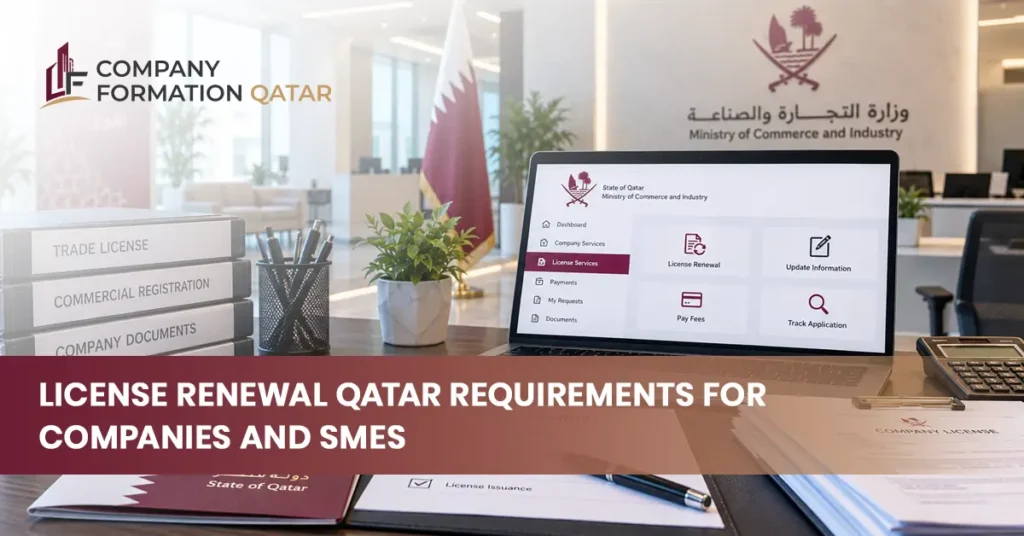
Timely license renewal Qatar compliance is essential for companies and SMEs that want to continue their operations without avoidable administrative or regulatory issues. In Qatar, businesses must keep their Commercial Registration (CR), commercial license, business activity information, premises details, and applicable approvals current. The Ministry of Commerce and Industry (MOCI) advises businesses to renew their commercial registration and licenses 30 days before expiry, allowing sufficient time to address documentation or approval requirements. A commercial registration and a commercial license are closely connected but serve different purposes. The CR records the business and its registered information, while the commercial license authorizes the business to conduct approved activities from a specified premises. Understanding this distinction helps companies manage their renewal obligations correctly and avoid treating the two records as interchangeable. What Is a Commercial License Renewal in Qatar? A commercial license permits a business to conduct approved commercial activities from its registered location. It confirms that the business premises and activities meet the applicable licensing requirements. The Commercial Registration, on the other hand, provides the official record of the business, including information such as its legal form, activities, ownership, and other registration details. Both records should remain valid and consistent with the company’s actual operations. A company that changes its activities, premises, ownership, management, or other important information may need to update its records before or as part of the renewal process. Renewal obligations can apply to companies, branches, individual establishments, retail businesses, service providers, and other licensed commercial entities. Additional requirements may apply to regulated activities or businesses that require approval from another government authority. When Should Companies Renew Their Commercial License in Qatar? Businesses should begin the renewal process well before their existing records expire. MOCI recommends renewing commercial registrations and licenses 30 days before expiry. This provides a practical period for reviewing information, obtaining approvals, correcting discrepancies, and completing the electronic application. Recommended 30-Day Renewal Timeline A company should ideally begin by checking its CR and commercial license expiry dates. It should then verify its registered trade name, activities, premises, authorized signatory, ownership information, beneficial ownership details, branches, and applicable approvals. Starting approximately one month in advance is particularly important for companies operating in regulated sectors or maintaining several branches and commercial activities. What Happens If the License Is Not Renewed on Time? Failure to renew can create compliance and administrative difficulties. An expired commercial license may affect the company’s ability to demonstrate that its business activities and premises remain properly authorized. Companies should therefore avoid treating renewal as a last-minute administrative task. Early preparation reduces the possibility of delays caused by missing documents, outdated information, or pending external approvals. Can a Business Continue Operating With an Expired License? Businesses should not assume that normal commercial operations can continue after the relevant license has expired. MOCI states that a Commercial Register may be written off where it has not been renewed and 90 days have passed after notification. Maintaining valid records is therefore an important part of ongoing business compliance in Qatar. Qatar Commercial License Renewal Requirements for Companies The exact requirements depend on the company’s legal structure, registered activities, premises, and regulatory obligations. However, most businesses should review several important areas before submitting a renewal application. Valid Commercial Registration The company’s Commercial Registration should be active and contain accurate information. Businesses should check their trade name, legal form, registered activities, ownership information, manager details, and other data against their current operations. Any material discrepancy should be addressed through the appropriate Ministry procedure rather than being ignored during renewal. Authorized Signatory Information The authorized signatory or responsible manager should have valid identification and appropriate authority to complete the relevant transaction. Companies should ensure that the information recorded with the authorities remains current before beginning the application. Required Third-Party Approvals Certain activities require approvals from other government entities. The requirements depend on the nature of the business and the sector in which it operates. Companies should identify applicable approvals in advance because an incomplete approval can delay the renewal process. Civil Defense Approval Where Applicable Civil Defense requirements can apply depending on the business premises and activity. MOCI investor guidance indicates that a Civil Defense certificate is required for commercial-license renewal where the site area exceeds 250 square meters. Businesses should verify the requirement applicable to their specific premises rather than assuming that every license follows the same approval process. Valid Business Premises and Supporting Documents The registered business premises should correspond with the company’s licensing information. Companies should review premises documentation, lease information, signage requirements, and any location-specific approvals before renewal. Beneficial Ownership Information Beneficial ownership information is an important part of Qatar’s current commercial-registration framework. MOCI requires relevant legal persons and legal arrangements to declare their beneficial owner when applying for registration, amendment, or renewal of the Commercial Register. Companies should therefore ensure that their beneficial ownership information is available and accurate before submitting a renewal application. Documents Required for License Renewal in Qatar The documentation required can vary according to the company’s activity and legal structure. A practical checklist may include: Current Commercial Registration details Existing commercial license information Authorized signatory or responsible manager identification Civil Defense certificate, where applicable Required third-party approvals Current premises and supporting documents Beneficial ownership information, where applicable Additional documents required for specific activities or branches Businesses should verify the exact requirements applicable to their establishment before submitting the application. Preparing the documents in advance can reduce the risk of an incomplete submission. How to Renew a Commercial License in Qatar The renewal process can generally be completed through Qatar’s electronic business-service infrastructure, subject to the requirements applicable to the business. Step 1 – Review Your Current CR and License Begin by checking the expiry dates and reviewing all information recorded on the CR and commercial license. Confirm that the business name, activities, premises, ownership, management, and other information remain accurate. Step 2 – Check Business Activities and Approvals Review every registered activity and confirm that it accurately reflects the company’s
Trademark Registration in Qatar
Blog

Trademark Registration in Qatar What to Know Before Applying With MOCI

Trademark registration in Qatar is an important step for businesses that want legal protection for a brand name, logo, symbol, or other distinctive mark used in the market. Before applying to the Ministry of Commerce and Industry (MOCI), applicants should check whether the mark is available, choose the correct class of goods or services, prepare the required documents, and understand the examination and publication stages. A well-prepared application can reduce avoidable delays and help a business protect its brand from conflicting registrations and unauthorised use. For businesses establishing or expanding their presence in Qatar, brand protection should form part of the wider commercial setup. Company Formation Qatar can help businesses understand the registration requirements and prepare for the application process while keeping their wider business structure in view. What Is Trademark Registration in Qatar? A trademark identifies the goods or services of one business and distinguishes them from those of other businesses. Registration gives the owner formal legal protection for the mark within the scope of the registration. MOCI states that a registered trademark receives protection for 10 years and can be renewed. For businesses planning trademark registration in Qatar, the registration process is more than submitting a logo and paying a fee. MOCI examines the application, and an accepted mark proceeds to publication. Third parties have an opportunity to oppose the registration during the prescribed publication period. If no successful opposition prevents registration, the applicant completes the final registration stage and receives the certificate. Who Can Apply for a Trademark in Qatar? MOCI provides trademark registration services for individuals, institutions, and companies. Applicants should provide information and documents appropriate to their status and the nature of the application. Where an agent represents the applicant, the relevant power of attorney must meet the applicable authentication and certification requirements. A business does not need to treat trademark protection as an afterthought. Entrepreneurs can consider brand protection while preparing their wider commercial activities, particularly where the proposed name or logo will appear on products, packaging, websites, advertising, or customer-facing services. What Should You Check Before Applying? A preliminary check is one of the most valuable steps before filing for trademark registration in Qatar. MOCI provides a self-search facility that allows users to search registered and published trademarks. Applicants can search the relevant database by selecting Qatar as the intellectual property office and entering the proposed mark. The search should not focus only on an identical word or logo. Similarity in appearance, pronunciation, meaning, and the goods or services involved can also create a potential conflict. A mark that appears available at first glance may still face objections or opposition. Why Does Trademark Class Selection Matter? Trademark protection is linked to the goods and services covered by the application. Applicants therefore need to identify the classes that correspond with their actual commercial activities and planned use of the mark. Choosing too narrow a scope can leave important business activities insufficiently protected, while an unnecessarily broad application can increase costs without providing practical value. The goods and services description should be specific, accurate, and consistent with the business’s intended use. What Documents Are Required? MOCI’s current registration information identifies several key requirements. These include an image of the trademark, a properly authenticated and certified power of attorney where an agent is used, an identity card copy for relevant local individual applications, proof of priority where priority is claimed, and translations where documents are submitted in another language. MOCI also requires evidence of practising the relevant profession or activity. Requirements can depend on the applicant and circumstances. Applicants should review current MOCI requirements before submitting. How Does the MOCI Trademark Registration Process Work? The process follows several stages, beginning with electronic submission and ending with the issue of the registration certificate. Step 1: Submit the Application The application is submitted electronically through MOCI’s website. The applicant provides the required information, uploads the supporting documents, identifies the relevant class or classes, and pays the application fee. Step 2: MOCI Examines the Application MOCI reviews the application against the applicable requirements. Its current service information states that the review stage is scheduled within 90 days, while the overall service duration is listed as 180 working days. If MOCI identifies an issue, the applicant may need to respond or correct the application within the applicable legal timeframe. Careful preparation before filing can therefore reduce the risk of avoidable complications. Step 3: Publication of the Trademark Once the application is accepted, the applicant pays the publication fee. MOCI then publishes the trademark in the Industrial Property Gazette for 60 days. This publication gives third parties an opportunity to raise an opposition in accordance with the applicable procedure. Step 4: Opposition Period A third party that believes the proposed registration conflicts with its rights may file an opposition within the prescribed period. MOCI provides a specific opposition service and requires supporting documents explaining the grounds of the objection. Applicants should not assume that publication means the trademark has already received final protection. The registration is completed only after the required stages have been successfully concluded. Step 5: Final Registration and Certificate After the publication period ends, MOCI notifies the applicant to pay the final registration fee. Once the required payment and formalities are completed, the trademark certificate is issued. The registration provides protection for 10 years, subject to the applicable renewal rules. How Much Does Trademark Registration Cost in Qatar? MOCI’s current published fees list QR1,000 for a trademark registration application, QR500 for publication, and QR3,000 for registration and issuance of the certificate. These are official government service fees and should be checked against MOCI’s current schedule before filing because administrative requirements and fee schedules can change. Applicants should also consider professional costs if they appoint an adviser or representative. Additional expenses may arise from document authentication, translation, responding to objections, or handling an opposition. How Long Does Trademark Registration Take? MOCI currently lists 180 working days as the service duration for trademark registration. The process includes examination, publication,

Commercial Bank Account Opening in Qatar
Blog

Commercial Bank Account Opening in Qatar Step by Step Guide

A business needs a dedicated banking arrangement to receive customer payments, pay suppliers, manage payroll, settle government fees, and maintain clear financial records. The commercial bank account opening in Qatar process involves document checks, customer due diligence, ownership verification, and bank compliance review. For businesses working with Company Formation Qatar, understanding the account-opening process before approaching a bank can reduce avoidable delays. Requirements can vary between banks according to the company’s legal form, ownership, business activity, expected transactions, and risk profile. This guide explains the documents, steps, compliance checks, and common issues businesses should consider in 2026. What Is a Commercial Bank Account in Qatar? A business bank account is an account opened in the name of a legally registered company or other eligible business entity. It separates company transactions from the personal finances of shareholders, directors, or employees. A commercial account can support routine business activities such as receiving sales proceeds, paying operating expenses, transferring funds, issuing payments, and managing employee salaries. Depending on the bank and account package, businesses may also receive access to online banking, payment facilities, cheque services, local transfers, and international transactions. Businesses should not treat a personal account as a substitute for a corporate banking relationship. Qatar’s banking framework distinguishes commercial activity from personal banking, so companies should establish the appropriate account structure for their operations. Documents Required to Open a Commercial Bank Account Banks normally request documents that prove the company’s legal existence, ownership, management, business activity, and authorised signing arrangements. The exact requirements can differ between banks and according to the company’s circumstances. Commercial Registration A valid Commercial Registration is one of the main documents used to establish the company’s legal identity. Banks may also check whether the registered activities correspond with the business activities described in the application. Commercial Licence Where applicable, the bank may request the company’s Commercial Licence or evidence of the relevant business licence. This helps confirm that the business is authorised to conduct its stated activities. Articles of Association The Articles of Association or equivalent constitutional documents help the bank understand the company’s legal structure, ownership, management powers, and signing authority. Tax Card A bank may request the company’s Tax Card or related tax documentation as part of its corporate file. Applicants should provide current documents and ensure that the company details remain consistent across all records. Establishment Card The Establishment Card may be requested to verify the company’s establishment and registration information. Requirements can vary according to the bank and account type. Identification Documents Banks commonly require identification documents for shareholders, beneficial owners, directors, managers, and authorised signatories, depending on their role and ownership level. Non-Qatari individuals may also need to provide passport and residency documentation. Authorised Signatory Documents The bank needs evidence showing who has authority to operate the account on behalf of the company. This can include authorised signatory information recorded in corporate documents and supporting identification. Board Resolution or Authorisation Letter Depending on the company’s structure, the bank may require a board resolution, mandate letter, or other authorisation confirming account-opening authority and signing arrangements. For example, QNB’s corporate account requirements include Commercial Registration, Articles of Association, Commercial Licence, Tax Card, Establishment Card, identification documents, and a mandate letter or board resolution. The bank also lists corporate KYC and tax-related forms among its requirements. How to Open a Commercial Bank Account in Qatar? Step 1: Choose a Suitable Qatar Bank Start by comparing banks according to the company’s transaction requirements. Consider online banking, local and international transfers, salary processing, payment services, branch access, minimum balance conditions, fees, and support for the company’s ownership structure. Do not select a bank only because it has a familiar name. A company expecting frequent international payments may have different requirements from a local business that mainly receives domestic transfers. Step 2: Prepare the Required Documents Collect the corporate documents before submitting the application. Check company names, registration numbers, addresses, ownership details, authorised signatories, and document validity. A mismatch between the Commercial Registration, Articles of Association, identification documents, or application form can lead to additional questions. Company Formation Qatar can help businesses organise their corporate information before they approach a bank. Step 3: Submit the Account Opening Application The application normally requires information about the company, its activities, shareholders, beneficial owners, expected transactions, source of funds, and authorised users. Some banks provide digital application channels. QNB, for instance, allows eligible companies to begin a corporate account application online and upload relevant company documents. The bank states that signatories may still need to complete verification at a branch before finalisation. Step 4: Complete KYC Verification Know Your Customer checks help banks establish who owns and controls the company and understand the purpose of the banking relationship. Applicants should provide accurate information about beneficial owners, directors, shareholders, business activities, expected transaction volumes, and source of funds. Qatar’s Ministry of Commerce and Industry requires commercial companies to maintain information and records relating to beneficial ownership and company structure. These records form an important part of corporate transparency and may support the bank’s own compliance assessment. Step 5: Complete Signatory Verification People authorised to operate the account may need to provide identification, signatures, or other verification. The bank can also confirm whether their authority matches the company’s constitutional documents and internal resolutions. If more than one signatory is required, the company should understand whether transactions require one signature, two signatures, or another approval arrangement. Step 6: Complete the Bank’s Compliance Review The bank may assess the company’s business model, ownership structure, country exposure, expected transaction activity, source of funds, and overall risk profile. Additional documents may be requested if the company operates in a regulated or higher-risk sector, has a complex ownership structure, includes foreign shareholders, or expects significant international transactions. Providing a clear and consistent business profile can reduce unnecessary back-and-forth during the review. Step 7: Receive the Business Account and IBAN Once the bank completes its checks and approves the application, it can activate the account and provide the relevant

Document Attestation Services in Qatar
Blog

Document Attestation Services in Qatar for Company and Immigration Needs

Businesses, employees, investors, and families often need officially authenticated documents before they can use them for legal, commercial, employment, educational, or immigration purposes in Qatar. Document attestation services in Qatar help establish the legal validity of documents issued locally or abroad so that they can be presented to the relevant authorities. The exact procedure depends on the document type, country of issue, and purpose for which the document will be used. For companies, attestation may be required for commercial contracts, powers of attorney, certificates, employment documents, and other business records. For individuals, educational certificates, marriage certificates, birth certificates, and employment documents may require authentication for immigration or professional purposes. Company Formation Qatar provides professional support to businesses and individuals that need assistance with document preparation, authentication procedures, and Qatar Ministry of Foreign Affairs requirements. What is Document Attestation in Qatar? Document attestation services in Qatar refer to the process of verifying and certifying documents so they can receive legal recognition for their intended use. Attestation confirms that the document has passed through the required authentication authorities and contains the appropriate seals and signatures. Qatar’s Ministry of Foreign Affairs provides attestation services for several categories, including commercial, civil, personal-status, judicial, educational, medical, and other documents. The applicable requirements and fees vary according to the document type. For foreign-issued documents, the process may involve authentication in the country where the document was issued, followed by authentication through the relevant Qatari diplomatic mission and completion of procedures in Qatar. Qatar MOFA also provides an overseas document-attestation service for foreign-issued educational, personal-status, judicial, and other documents. Why Do Companies Need Document Attestation? Businesses operating in Qatar may need authenticated documents for corporate transactions, commercial activities, employment procedures, contractual matters, and dealings with government or private organisations. Commercial Documents Commercial documents may include certificates of origin, packing lists, business contracts, commercial invoices, and commercial powers of attorney. Qatar MOFA lists these documents under its commercial legalisation services and specifies applicable fees according to the document type. Company Agreements Companies may need to authenticate agreements when documents are intended for use before government bodies, business partners, financial institutions, or other organisations. The authentication requirements depend on the nature and origin of the document. Powers of Attorney Commercial powers of attorney may require authentication when a representative is authorised to act on behalf of a company. Qatar MOFA includes commercial powers of attorney among the commercial documents covered by its legalisation services. Certificates and Business Records Companies may also need authenticated certificates and business records when establishing commercial relationships or completing procedures involving foreign authorities. Businesses should confirm the required chain of authentication before submitting documents because missing seals, signatures, or prior authentication can prevent completion of the process. Why Is Attestation Important for Immigration? Immigration-related procedures often require individuals to prove personal, educational, or professional information through officially recognised documents. This makes document authentication particularly important for expatriates moving to Qatar or residents completing family, employment, or professional procedures. Educational Certificates Educational certificates may be required for employment, professional classification, or other official procedures. Qatar MOFA states that foreign university degrees submitted for attestation must meet applicable recognition requirements, and university certificates issued outside Qatar must be submitted with a transcript. Marriage Certificates Marriage certificates may need authentication when individuals complete family-related procedures or need to establish a legal marital relationship before an authority in Qatar. Birth Certificates Birth certificates can be relevant for family and residency procedures where proof of relationship or personal status is required. Employment Certificates Employment and experience certificates may be requested to establish professional history or support employment-related procedures. The appropriate authentication route depends on where the document was issued and the authority that originally certified it. How Does Document Attestation Work in Qatar? The exact procedure depends on the document and its country of origin. Applicants should identify all required authentication stages before submitting an application. Document Preparation The first step is to identify the document and check whether it meets the relevant requirements. Qatar MOFA states that documents submitted for legalisation should contain the required seals and signatures from authorised entities. Documents may need to be presented in Arabic, English, or with a certified translation. Home Country Authentication Foreign-issued documents may first need authentication by the competent authority in the country of origin. The required authority varies according to the country and document category. For example, an educational certificate may need authentication from the issuing educational institution and relevant government authorities before it can proceed to the next stage. Qatar Embassy Attestation Depending on the document and country, authentication may involve the Qatari diplomatic mission in the country where the document was issued. Qatar MOFA’s overseas service allows foreign documents to undergo the necessary procedures through the relevant Qatari mission. Qatar MOFA Attestation The final stage may involve Qatar MOFA’s Consular Affairs Department. Applications can be submitted through the MOFA website, while applicable government service centres and the Consular Affairs building also provide attestation services. The Ministry also provides electronic attestation for certain eligible documents. Its digital services include police clearance certificates issued by Qatar’s Ministry of Interior and educational certificates issued by government schools and authenticated by the Ministry of Education and Higher Education. How Are Foreign Documents Attested for Qatar? Foreign documents require particular attention because the authentication process can involve authorities in more than one country. Educational Documents Foreign educational certificates should satisfy Qatar’s recognition requirements before they are submitted. Qatar MOFA specifies that university degrees must come from accredited and recognised universities included in the relevant approved list. Applicants should also prepare transcripts where required. Qatar MOFA specifically states that university certificates issued outside Qatar must be submitted with a transcript. Personal Documents Personal-status documents such as marriage and birth certificates may need authentication in the issuing country before they can be used in Qatar. The required process depends on the document and country of origin. Commercial Documents Foreign companies may need to authenticate contracts, certificates of origin, invoices, powers of attorney, and other

Company Formation in Qatar
Blog

Company Formation in Qatar: A Complete Guide for Investors 2026

Qatar continues to attract entrepreneurs, international investors and businesses looking for opportunities in the Gulf region. Its expanding economy, strategic location, modern infrastructure and investor-focused initiatives have created an attractive environment for establishing new businesses. For investors planning company formation in Qatar, choosing the correct legal structure, business activity and registration route is essential for establishing a compliant and sustainable operation. The process involves more than registering a business name. Investors must determine the appropriate company structure, identify licensing requirements, prepare documentation, satisfy ownership conditions and complete the relevant registration procedures. Depending on the proposed activity and ownership structure, investors may establish a mainland entity through the Ministry of Commerce and Industry (MOCI), establish an entity through the Qatar Financial Centre (QFC), or consider other available investment platforms. Why Choose Qatar for Company Formation in 2026? Qatar offers investors access to a developed business environment supported by modern infrastructure and a strategic position within the Gulf. The country’s continued economic diversification has created opportunities beyond traditional energy-related industries, including professional services, technology, logistics, manufacturing, tourism and other sectors. Foreign investment rules have also developed considerably. MOCI states that non-Qatari investors may own up to 100% of the capital in permitted economic activities under Qatar’s foreign investment framework, subject to applicable conditions and exclusions. Certain sectors, including banking and insurance, are subject to specific restrictions or exceptions. The Qatar Financial Centre also provides an onshore platform for eligible businesses, offering up to 100% foreign ownership and a streamlined incorporation and licensing process. These options give investors greater flexibility, but the right route depends on the proposed activity, ownership requirements, target customers and regulatory environment. What Are the Company Formation Options in Qatar? Investors should select the registration jurisdiction according to the nature of their business rather than simply choosing the quickest available option. The main routes include mainland registration, QFC registration, free-zone structures and branches of foreign companies. For investors considering company formation in Qatar, understanding the difference between these routes is one of the first strategic decisions. Mainland Company A mainland company is generally established through the relevant procedures administered by MOCI. It can be suitable for businesses intending to operate within Qatar’s local commercial market, provided the proposed activity and ownership arrangement satisfy applicable requirements. MOCI recognises several legal forms, including limited liability companies, shareholding companies, partnerships and holding companies. The permitted structure depends on the company’s intended activities and ownership arrangement. Qatar Financial Centre The QFC provides a separate onshore legal and regulatory environment for eligible businesses. It allows several types of entities, including limited liability companies, holding companies, special purpose companies, partnerships and branches. QFC states that eligible entities can have up to 100% foreign ownership. The QFC route can be particularly relevant for businesses whose activities fall within its permitted scope and that want to operate under its legal and tax framework. Qatar Free Zones Qatar’s free-zone environment can be relevant for investors establishing businesses focused on areas such as logistics, manufacturing, technology and international trade. Investors should assess the relevant free-zone rules, licensing conditions and permitted activities before choosing this route. Branch Office A foreign company may establish a branch in Qatar where the applicable requirements are satisfied. MOCI indicates that a branch must generally use the same name as its parent company and conduct the activities stated in its incorporation documents. A branch therefore differs from a separately incorporated local company because it represents an extension of the foreign parent rather than an entirely independent corporate entity. Which Company Structure Is Right for Investors? Selecting the correct legal form affects ownership, liability, governance, documentation and ongoing compliance. Limited Liability Company An LLC is a commonly considered structure for businesses seeking limited liability. Under MOCI’s company classifications, partners’ liability is generally limited to their respective interests in the company’s capital. MOCI also states that an LLC can have between two and 50 partners in the structure described on its company-types page. Investors should nevertheless confirm the current requirements applicable to their proposed activity and ownership arrangement before incorporation. Joint Stock Company A joint stock structure may be appropriate for larger businesses with more complex ownership and capital requirements. Public and private shareholding companies operate under different rules from ordinary LLCs and may involve more extensive governance and capital requirements. For example, MOCI states that a private shareholding company requires at least five founding shareholders and capital of not less than QR2 million. Holding Company A holding company is designed to control other companies or investments rather than operate solely as a conventional trading business. MOCI describes a holding company as an LLC, shareholding company or sole proprietorship that financially and managerially controls one or more companies. Investors should establish this structure only where it aligns with their investment strategy and intended activities. Can Foreign Investors Own 100% of a Company in Qatar? Foreign ownership is one of the most important considerations for international investors. Qatar’s foreign investment framework permits non-Qatari investors to own up to 100% of a company’s capital in permitted sectors, subject to applicable legal requirements and exclusions. MOCI specifically notes that certain areas, including banks and insurance companies, are restricted unless an applicable exception is granted. The ownership position can therefore depend on the exact business activity rather than nationality alone. The QFC separately offers eligible businesses the possibility of up to 100% foreign ownership. Investors should verify ownership eligibility before preparing incorporation documents because selecting an activity that does not support the intended ownership structure can create delays or require a change in the proposed setup. What are the Requirements for Company Formation? The exact requirements depend on the legal structure, activity, ownership and registration route. However, investors normally need to establish several fundamental elements before submitting an application. For company formation Qatar, the first step should be identifying the precise commercial activity. Licensing and ownership requirements can differ between activities, particularly where a business operates in a regulated sector. Choosing a Business Activity The proposed activity should accurately reflect

Blog

Business License in Qatar 2026: Types, Costs and Requirements

Starting a company in Qatar requires more than registering a business name. Entrepreneurs must select the appropriate business activity, establish the correct legal structure, obtain commercial registration, secure suitable premises where required, and obtain the necessary licence before beginning operations. A business license in Qatar confirms that an establishment is authorised to conduct its approved commercial activity at a specified location. Qatar continues to develop its business environment through digital government services and streamlined company formation procedures. The Ministry of Commerce and Industry (MOCI) provides Single Window services that allow investors to establish and maintain businesses through a central digital platform. In June 2026, MOCI also began updating registered commercial activities in line with the GCC Unified Economic Guide for the Classification of Economic Activities. What Is a Business License in Qatar? A commercial licence authorises a business to conduct approved activities at a licensed premises. It is separate from the Commercial Registration (CR), although both form important parts of the business establishment process. The CR records the business in Qatar’s Commercial Registry, while the commercial licence relates to permission to operate the approved activity from the specified location. MOCI’s Commercial Registration and Licenses Department is responsible for reviewing applications and issuing commercial licences. Businesses must operate only within the activities permitted by their commercial registration and licence. MOCI also requires businesses to display their commercial register and licence prominently at the licensed premises and renew them before expiry. What Types of Business Licences Are Available in Qatar? The appropriate licence depends on the nature of the business and its activities. Commercial Licence This is commonly used by businesses operating commercial establishments and branches. Retail shops, trading businesses, restaurants, and various service establishments may require commercial licensing depending on their registered activities and premises. Professional Licence Businesses providing professional or specialised services may require licensing arrangements appropriate to their approved activities. Additional professional or sector-specific approvals may apply depending on the nature of the service. Industrial Licence Manufacturing and industrial operations are subject to additional requirements. Industrial projects can require an industrial project establishment licence and registration with the relevant authorities. MOCI provides separate procedures for industrial licensing and related approvals. Home-Based Business Licence Certain eligible activities can operate from home under a home-based business licence. MOCI’s published fee schedule lists the annual fee for a home-based business licence at QAR 300. Activity-Specific Licences and Approvals Some activities require approval from other government bodies in addition to MOCI registration and licensing. Regulated sectors can therefore involve additional documentation, inspections, technical requirements, or professional approvals. What Are the Requirements for a Business License in Qatar? The exact requirements depend on the selected activity, legal structure, premises, ownership arrangement, and any sector-specific regulations. Common requirements include: Approved business activity Trade name Commercial Registration Appropriate legal structure Identification documents Articles of Association or incorporation documents where applicable Valid premises and lease documentation Details of the responsible manager Required approvals from competent authorities Activity-specific certificates or permissions where applicable Businesses should confirm the activity requirements before committing to premises. MOCI specifically advises investors to obtain preliminary approval from the Commercial Licences Department before signing a lease for the site to be licensed. How Much Does a Business License Cost in Qatar in 2026? The cost depends on the licence type and the nature of the business. The standard MOCI fee schedule currently lists the annual fee for licensing a commercial, industrial, or similar public establishment or branch at QAR 500. The annual renewal fee is also QAR 500. A home-based business licence is listed at QAR 300 annually. However, the licence fee is not necessarily the total cost of establishing a business. Entrepreneurs may also need to budget for: Commercial Registration fees Trade name-related charges Lease and premises costs Municipality-related requirements Approvals from other authorities Professional or sector-specific licensing Document attestation and translation Company incorporation expenses Service-provider or consultancy fees Therefore, the total setup budget should be calculated according to the company’s activity and structure rather than relying on the commercial licence fee alone. How to Get a Business License in Qatar? Understanding how to get a business license helps entrepreneurs organise the establishment process and avoid unnecessary delays. 1. Select the Business Activity The first step is identifying the exact economic activity the company intends to conduct. The activity determines the applicable requirements, approvals, and licensing conditions. This step has become particularly relevant in 2026 because MOCI began updating commercial activity classifications from June 2026 under the GCC Unified Economic Guide. The ministry stated that the update does not change the nature of the registered activity or Commercial Registration. 2. Choose the Legal Structure The founder should select an appropriate legal form, such as a limited liability company, branch, or another permitted structure. The decision can affect ownership, documentation, management, and licensing requirements. 3. Reserve the Trade Name The proposed business name must comply with Qatar’s applicable commercial naming requirements. Entrepreneurs should also ensure that the selected name is suitable for the intended business activity. 4. Complete Commercial Registration The company must obtain its Commercial Registration before the commercial licence can generally be issued. MOCI’s electronic services provide establishment and renewal services through the Single Window platform. 5. Secure Suitable Premises Where the activity requires a physical location, the premises must meet the applicable requirements. Businesses should confirm licensing suitability before finalising the lease. 6. Submit the Licence Application After meeting the applicable requirements, the applicant submits the commercial licence application with the required information and supporting documents. MOCI states that commercial licences can be applied for through its electronic services or ministry branches. 7. Obtain Additional Approvals Certain activities require approval from other government entities. The requirements can vary considerably between sectors, so applicants should confirm all approvals before commencing operations. Can Foreigners Obtain a Business License in Qatar? Yes, Qatar’s investment framework allows 100% foreign ownership in multiple sectors, subject to the applicable law, regulations, and activity restrictions. Qatar’s Foreign Investment Law, Law No. 1 of 2019, provides a framework

company share transfer in Qatar
Blog

Company Share Transfer in Qatar 2026: Requirements and Process

A company share transfer in Qatar is more than an agreement between a seller and buyer. For a limited liability company (LLC), the transfer must follow the company’s incorporation document, existing partners may have statutory rights where shares are sold to an outsider, and the ownership change needs to be properly recorded before it becomes effective against the company and third parties. The exact process also depends on what is being transferred. An LLC interest, shares in a shareholding company and ownership in a Qatar Financial Centre entity do not all follow the same route. For businesses planning to transfer company shares in Qatar in 2026, identifying the legal form and resulting ownership structure should therefore come before preparing the transfer documents. Can Company Shares Be Transferred in Qatar? Yes. Qatar law allows company ownership interests to be transferred, but the procedure and restrictions depend on the legal form of the company. For an LLC, Qatar’s Commercial Companies Law allows a partner to transfer their share to another existing partner or to a third party through an official instrument, subject to the company’s incorporation document. The distinction between an existing partner and an outside buyer is particularly important. A transfer for consideration to someone who is not already a partner can trigger statutory rights for the other LLC partners. A company share transfer in Qatar should therefore begin by establishing who is transferring the interest, who will receive it and what the company’s constitutional documents say about that transaction. First Identify the Type of Company Using one transfer procedure for every Qatar entity can result in the wrong documents, approvals or registration route. Limited Liability Company: The LLC provisions of the Commercial Companies Law govern the transfer, together with the company’s incorporation document and registered ownership records General Partnership: Transfer restrictions are generally stronger and the partnership agreement and consent requirements need to be examined Public or Private Shareholding Company: Share transfers follow the rules applicable to shares and shareholder registers rather than the LLC quota-transfer procedure QFC Company: Companies established in the Qatar Financial Centre operate within the QFC’s separate legal and regulatory framework and should not automatically follow the ordinary MOCI LLC process** What Are the Main Requirements for an LLC Share Transfer? For an LLC, the transaction needs to move from a private commercial agreement to an officially recognised ownership change. Requirement Why it matters Review incorporation document Identifies company-specific transfer restrictions Confirm seller and buyer Determines whether third-party transfer rules apply Agree transfer terms Establishes the interest and consideration being transferred Check partner rights Existing partners may have priority in an external sale Prepare official instrument Required for the LLC transfer Update partners’ register Records the new internal ownership position Update Commercial Register Makes the change effective against third parties Review foreign ownership New ownership must remain legally permitted Check beneficial ownership UBO information may change with the transaction These steps should be considered as one process rather than independent administrative tasks. Review the Incorporation Document Before Agreeing the Sale The company’s incorporation document is one of the first records that should be checked in a credit— or, more accurately, share transfer transaction. For an LLC, the Commercial Companies Law expressly makes the transfer of a partner’s interest subject to the company’s incorporation document. That document can therefore affect how a proposed transfer proceeds. The review should establish the current ownership percentages, whether the proposed buyer is already a partner, whether any transfer restrictions exist and whether the transaction changes management or other provisions that also need amendment. The resulting structure should also be checked before the sale is finalised. A transfer that is commercially agreed but creates an impermissible ownership structure can require further approvals or restructuring before registration. Selling to an Existing Partner Is Different From Selling to an Outsider This distinction is central to Qatar’s LLC rules. If one partner transfers an interest to another existing partner, the transaction does not create the same third-party admission issue as selling the interest to someone who is currently outside the company. Where a partner proposes to transfer their interest for consideration to a non-partner, Qatar’s Commercial Companies Law provides a statutory mechanism protecting the existing partners, unless the incorporation document provides otherwise. That means an outside buyer should not assume that signing terms with the seller alone guarantees completion. Existing Partners Can Have a 30-Day Priority Period When an LLC interest is being sold for consideration to someone who is not already a partner, the proposed transaction must be communicated through the company manager so that the other partners are informed of the transfer terms. Existing partners can then seek to acquire the interest under the statutory mechanism. If the price becomes disputed, the law provides a valuation mechanism involving the company’s auditor. Where no partner exercises the applicable right within 30 days from notification, the transferring partner becomes free to proceed with the sale to the outside party. This is one of the most important requirements to identify before trying to transfer company shares in Qatar. A transaction with a third-party buyer can therefore involve a built-in statutory period that does not normally arise in the same way when ownership is simply being redistributed between existing partners. The Transfer Requires an Official Instrument A verbal agreement, unsigned term sheet or private commercial understanding does not by itself complete an LLC ownership transfer. Qatar’s Commercial Companies Law requires the transfer to take place through an official instrument, subject to the incorporation document. The transfer documentation should clearly identify the seller and buyer, the ownership interest being transferred, the agreed consideration where applicable and the ownership position resulting from the transaction. The precise documentation and authentication route should be checked against the current government procedure and the circumstances of the parties. A foreign corporate buyer, for example, can require a different supporting document set from an individual already resident in Qatar. Updating the Partners’ Register Is a Legal Step, Not Housekeeping An LLC must maintain

Blog

Company Classification Certificate in Qatar 2026: How to Apply

Starting or expanding a business in Qatar often involves more than obtaining a commercial registration and commercial licence. Companies that want to participate in certain government tenders, supplier programmes, or contracting opportunities may also need to provide evidence of their technical, financial, and operational standing. A Company Classification Certificate in Qatar can form part of these requirements, depending on the relevant authority, procurement system, or business activity. In 2026, businesses should also pay attention to Qatar’s updated commercial activity classification framework. The Ministry of Commerce and Industry began updating registered commercial activities from June 2026 in line with the Unified Economic Guide for the Classification of Economic Activities adopted by GCC countries. The Ministry stated that the update aims to improve accuracy and consistency in activity classification and does not change the nature of the existing commercial registration. What is a company classification certificate in Qatar? A company classification certificate is a document used in certain procurement, supplier-registration, or contracting processes to demonstrate that a company meets specified classification requirements. The exact purpose and issuing process can vary according to the organisation requesting it. For example, Qatar’s Civil Aviation Authority supplier-registration portal asks applicants to provide a classification certificate number, classification level, expiry date, and a copy of the certificate. The General Authority of Customs also lists a copy of a classification certificate among documents required for supplier registration. This means businesses should not assume that classification is simply another form of company incorporation. Commercial registration establishes the company’s legal business identity, while a classification certificate may be relevant to a particular contracting, tendering, or supplier requirement. Why Is Company Classification Important in Qatar? Classification can become important when a company wants to work with government bodies, major institutions, or organisations that use supplier prequalification systems. Depending on the relevant authority, classification may help demonstrate the following: The company’s approved business activities. Technical and professional capabilities. Previous project experience. Financial capacity. Operational resources. Eligibility for specific procurement opportunities. Compliance with client or authority requirements. Who Needs a Company Classification Certificates in Qatar? Not every company in Qatar will need a classification certificate simply because it is incorporated or licensed. The requirement is more likely to arise where a company wants to register as a supplier, contractor, or service provider with an organization that requires classification evidence. Government procurement portals can request classification information as part of supplier registration. For example, the Civil Aviation Authority’s supplier-registration system includes fields for classification certificate number, level, and expiry date. Companies that may encounter such requirements include: Contractors. Engineering and technical service providers. Construction businesses. Specialist suppliers. Professional service providers. Companies seeking government procurement opportunities. Foreign businesses registering for specific supply or contracting activities. Requirements for Company Classification in Qatar The requirements depend on the classification system and the organization requesting the certificate. Businesses should therefore prepare their core corporate, financial, and operational records before starting an application. Valid Commercial Registration A company normally needs valid corporate registration information that matches the business applying for classification. The company name, registration details, ownership information, and business activities should be consistent across supporting documents. Valid Commercial Licence The commercial licence should cover the activities the company intends to perform. Businesses should review their registered activities carefully, particularly following Qatar’s 2026 commercial activity classification updates. Company and Ownership Information Authorities or procurement organisations may request information about the company’s owners, partners, authorised representatives, and persons responsible for signing contracts. Financial Information Depending on the classification, companies may need to demonstrate financial capacity through financial statements, banking information, or other financial documentation. Technical and Operational Capability A company may need to demonstrate that it has the personnel, equipment, technical resources, qualifications, and operational capacity required for its activities. Previous Projects and Experience Project references and evidence of previous work can be important when an authority evaluates whether a company has sufficient experience for a particular category or level. What Documents Are Required? There is no single document list that applies to every classification process in Qatar. The required documents depend on the authority and the purpose of classification. However, businesses may be asked to provide documents such as: Commercial Registration. Commercial licence or permit. Tax documentation. Identification documents for authorised signatories. Company profile. Financial statements. Bank information. Previous project records. Technical qualifications. Professional certificates. Existing classification certificate, where applicable. Other documents specified by the relevant authority. For example, the General Authority of Customs requires supplier applicants to provide documents including the Commercial Registration, commercial licence, bank certificate, establishment registration certificate, authorised signatory identification, classification certificate, and tax card. How to Apply for a Company Classification Certificate in Qatar? The application process depends on which authority or procurement system requires the classification. A company should not begin by assuming that the general Ministry of Commerce and Industry certificate service is the application route for every classification requirement. A practical process usually involves the following steps. Step 1: Identify the Required Classification First, determine which organisation requires classification and what level, category, or certificate it accepts. Review the tender documents, supplier-registration instructions, or prequalification requirements carefully. Step 2: Check Eligibility Confirm that the company’s legal structure, commercial activities, licence status, experience, and other requirements meet the relevant conditions. Step 3: Prepare the Required Documents Collect the corporate, financial, technical, and experience documents requested by the relevant authority. Make sure documents are current and that company information is consistent. Step 4: Submit the Application Complete the relevant online or authority-specific registration process. Some procurement portals require applicants to upload the classification certificate together with other company documents. Step 5: Pay the Applicable Fees If the relevant classification service includes a fee, the company should make the payment through the approved channel and retain the payment confirmation. Businesses should not confuse classification fees with the standard fees for certificates available through Qatar’s Single Window. The Single Window currently lists certain company certificate and extract services at specific fees, but those services are not necessarily the same as a procurement classification certificate.

Blog

Qatar Residency by Investment 2026: Golden Visa Requirements

Qatar offers attractive residency options for international investors, particularly those purchasing qualifying real estate. Qatar residency by investment provides a structured route for eligible non-Qatari property owners to obtain residency without relying on a traditional employment sponsor. In 2026, the main property-linked thresholds remain QAR 730,000 for a residency permit and QAR 3.65 million for residency with additional permanent-residency-related benefits. For investors considering Qatar as a long-term base, understanding the investment thresholds, qualifying properties, documentation, application process and residency conditions is essential. Qatar has also introduced new residency categories for entrepreneurs and senior executives in 2026, but these are separate from the property investment route. What Is Qatar Residency by Investment? Residency by investment allows eligible foreign property owners to obtain residency benefits based on qualifying real estate investment in Qatar. Under the current framework, non-Qatari investors can qualify through two main property-value categories: QAR 730,000 or more: The property owner can qualify for a real-estate residency permit without a sponsor, subject to the applicable conditions. QAR 3.65 million or more: The property owner can receive real-estate residency with additional benefits associated with permanent residency, including healthcare, education and certain investment privileges. The Ministry of Justice confirms that the property must be located in an eligible freehold or usufruct area. Applicants must also satisfy the applicable residency conditions. Does Qatar Have a Golden Visa Programme? The term ‘Golden Visa’ is often used when discussing long-term investor residency in Qatar. However, investors should identify the specific residency category rather than assuming that Qatar operates one universal visa under this name. Qatar’s property-linked residency framework provides different benefits according to the value of the qualifying real estate investment. A property valued at QAR 730,000 or more can qualify for real-estate residency, while a qualifying investment of at least QAR 3.65 million can provide residency with additional benefits linked to permanent residency. Qatar also launched new residency categories for high-growth entrepreneurs and senior executives in February 2026. These programmes are separate from property-based investor residency and have their own eligibility requirements. What Are the Qatar Residency by Investment Requirements in 2026? The requirements depend on the value and type of property being purchased. QAR 730,000 Property Investment A non-Qatari who purchases qualifying real estate valued at QAR 730,000 or more may obtain a residency permit without a sponsor. The Ministry of Justice states that the property must be situated in a designated freehold or usufruct area. The owner must also reside in Qatar for at least 90 days each year, either continuously or intermittently, to satisfy the stated residency condition. QAR 3.65 Million Property Investment Investors purchasing qualifying property valued at QAR 3.65 million or more, approximately US$1 million, can receive real-estate residency with additional benefits associated with permanent residency. These benefits include access to healthcare and education and the ability to invest in certain commercial activities, subject to the applicable rules. The Ministry of Justice also states that the 90-day annual residency condition applies to this category. Which Properties Qualify for Investor Residency? Not every property purchase automatically qualifies for residency. The property must fall within the areas and ownership arrangements permitted for non-Qatari investors. Qatar permits non-Qataris to own property through both freehold ownership and usufruct arrangements in designated areas. Freehold ownership provides broader property rights, while usufruct arrangements provide rights for a defined period. Before purchasing, investors should verify: Whether the property is in an eligible area Whether the property is freehold or usufruct Whether its value meets the relevant threshold Whether the title documentation is valid Whether the property can be used for the intended purpose Whether the purchase structure satisfies the applicable residency requirements The Ministry of Justice specifically provides a service for obtaining approval for real-estate residency and requires the property to be located in a qualifying freehold or usufruct area. How Does Qatar Property Investment Support Residency? Qatar property investment can provide more than an opportunity to acquire a real-estate asset. For eligible non-Qatari owners, it can also provide a route to property-linked residency. The investment decision should nevertheless be based on both commercial and immigration considerations. Investors should evaluate the property’s location, market value, rental potential, ownership structure, service charges and resale prospects rather than purchasing solely to obtain residency. The property should also be independently verified before the transaction is completed. Confirming eligibility before signing a purchase agreement can help prevent problems later in the residency application. How to Apply for Residency by Investment? The application process generally involves completing the qualifying property transaction and then applying for real-estate residency through the relevant procedures. Step 1: Select an Eligible Property Choose a property located within an area where non-Qatari ownership or usufruct is permitted. Step 2: Confirm the Investment Value Verify that the property’s value satisfies the applicable QAR 730,000 or QAR 3.65 million threshold. Step 3: Complete the Purchase Complete the legal and financial requirements for acquiring the property. Step 4: Obtain the Title Deed The Ministry of Justice requires a copy of the original title deed as part of the real-estate residency approval process. Step 5: Prepare Residency Documents Applicants should prepare the required identification and supporting documents. Step 6: Submit the Application Apply through the relevant Ministry of Justice process for approval of real-estate residency. Step 7: Complete Residency Procedures Once approval is obtained, complete the remaining procedures required to issue the residency permit. The Ministry of Justice currently lists the real-estate residency approval service as an online service and identifies a passport or Qatari ID, original title deed and certificate of good conduct for non-residents among the required documents. What Documents Are Required? The exact documentation can depend on the applicant’s circumstances and the residency category. However, the Ministry of Justice currently identifies several documents for real-estate residency approval. Applicants may need: Passport or Qatari ID Original property title deed Certificate of good conduct for non-residents Property-related documentation Residency application information Other supporting documents requested by the relevant authority Investors should ensure that names and personal details are consistent

Qatar Work Visa
Blog

Qatar Work Visa Requirements 2026: A Complete Guide for Expats

For foreign professionals planning to work in Qatar, understanding the qatar work visa requirements is an important part of preparing for employment. Qatar generally requires newcomers who intend to live and work in the country to obtain a Work Residence Permit through a Qatari employer. The employer normally handles the main immigration and residency procedures on behalf of the employee. The process involves employment documentation, immigration approval, medical examinations and the conversion of the entry visa into a residence permit. The requirements can vary depending on the employee’s nationality, profession, employer and circumstances. Some applicants may also need to complete medical checks and document verification before travelling to Qatar. Understanding each stage in advance can help employees prepare the correct documents and reduce avoidable delays. What Is a Qatar Work Visa? A Qatar work visa is an employment-related entry authorisation that allows an expatriate to enter Qatar for employment under an approved sponsor. For most foreign employees, the sponsoring employer manages the process and provides the documentation required for the application. The work visa should not be confused with the Work Residence Permit. The entry visa allows the employee to enter Qatar for the relevant purpose, while the residence permit establishes the employee’s legal residency in Qatar. According to Qatar’s official government portal, newcomers intending to work and live in Qatar require a Work Residence Permit and generally need a Qatari employer to sponsor them. After the employee arrives, the employer normally completes the procedures required to convert the temporary entry status into a Work Residence Permit. The government notes that this process typically takes around two to four weeks, although it can take longer depending on individual circumstances. Who Needs a Qatar Work Visa? Foreign nationals who intend to work and reside in Qatar generally require appropriate employment authorisation and residency sponsorship. The requirements apply to employees working for eligible employers across different sectors. Foreign Employees Expatriates recruited to work in Qatar generally need the appropriate employment and residence authorization before starting their jobs. The process is normally initiated by the sponsoring employer. Employer Sponsorship The employer generally acts as the employee’s sponsor and handles the required immigration and employment procedures. This includes submitting applications and providing relevant company documentation. Employment Contract A genuine employment relationship should be supported by a valid employment contract that clearly establishes the employee’s role and agreed employment terms. Government Approval Non-Qatari workers must obtain the appropriate authorisation under Qatar’s applicable labour and immigration rules. Employees should avoid accepting employment arrangements that do not provide a clear legal basis for working in Qatar. Medical Requirements Foreign workers may also need to complete the required medical procedures as part of obtaining their residence status. Applicants should follow the latest requirements issued by the relevant Qatar authorities. What are the Qatar Work Visa Requirements in 2026? The exact requirements depend on the employee and the sponsoring employer, but applicants should generally be prepared for several key requirements. Valid Passport A valid passport is essential for immigration procedures. The passport details used in the employment and visa application should match the information submitted to the authorities. Employees should check that their passport remains valid for the relevant period and contains sufficient space where applicable. Employment Contract The employment relationship should be documented through a valid employment contract. Qatar’s official labour guidance emphasises the importance of having a contract before travelling for employment. The employee should review the contract carefully, including the job title, salary, working conditions and other agreed employment terms. Employer Sponsorship Most expatriate employees require an eligible Qatari employer to sponsor their employment and residence. The employer normally initiates the relevant procedures and provides its establishment documentation. Medical Fitness Medical screening is an important part of the process. Qatar requires newcomers who intend to work and live in the country to undergo health screening before obtaining a Work Residence Permit. Educational and Professional Documents Depending on the profession, the employee may need to provide educational certificates, professional qualifications or other evidence supporting the position. Certain professions may have additional requirements, so applicants should confirm the documents required for their specific job before travelling. Police Clearance and Good Conduct Documents Some visa categories or employment situations can require a good conduct or police clearance certificate that has been properly authenticated. The exact requirement depends on the circumstances and the relevant authority. What Documents Are Required? The document list can vary by nationality, profession and employer, but applicants may be asked to provide: Original passport Passport photographs Employment contract Educational certificates Professional qualifications, where applicable Police clearance or good conduct certificate, where required Medical examination records Other documents requested by the employer or authorities How Does the Qatar Work Visa Process Work? The work visa process generally involves several stages handled jointly by the employer, employee, and relevant government authorities. Step 1: Secure an Employment Offer The process begins when a foreign worker receives an employment offer from a Qatar-based employer. The employee should review the employment contract and confirm the job title, salary and other important conditions before proceeding. Step 2: Employer Starts the Application The sponsoring employer submits the relevant application and supporting information to the appropriate authorities. The employer may need to provide establishment information and obtain the approvals required for recruiting foreign workers. Step 3: Complete Pre-Travel Procedures Depending on the employee’s nationality and circumstances, the applicant may be required to visit a Qatar Visa Centre or an approved facility in their country. Procedures can include contract verification, biometric registration and medical testing. Step 4: Receive the Entry Visa Once the required approvals are completed, the employee can receive the appropriate employment entry authorisation. The employee can then travel to Qatar according to the instructions provided by the employer. Step 5: Complete Medical Procedures in Qatar New workers must complete the required health screening after arrival where applicable. The Medical Commission conducts examinations for newcomers seeking a Work Residence Permit. Step 6: Complete Residence Permit Procedures The employer completes the remaining procedures

Scroll to Top